Each Friday Every so often, we share our Web discoveries, mostly pulled from our RSS feeds and Twitter accounts. If there's something we should know about, please write to thesadbear [at] gmail [dot] com.It's been a couple weeks since we shared links. These are pretty damn good ... perhaps a little media heavy, which is specifically my influence. But I tried to pluck from RSS feeds.
Up and Then Down (elevators)
Death of Caveman ends era in IdahoLord Jesus Christ hit by carNews from Wolf Parade
Wayne County ConfidentialBy elevator, it takes about a minute to get to the top of the historic Guardian Building, the new headquarters for Wayne County’s administrative offices that taxpayers recently paid 47 million dollars to buy and renovate. If you’re Channel 7, it’ll take you much longer: about 27 days. It would have taken even more time, but after the county put off our many requests for a tour of the public building, we decided we’d just show up.
Imprimis,
whatever that means,
however that's pronouncedPitbull pup poops in patrol carA Nonfiction Marriage
8-year-old can't understand roof banReasons given for staying off the roof have included the danger of falling off, the fragility of the shingles, and what someone driving by might think. "He knows he shouldn't be up there," Beth said. "That's that."
Fire destroys homeDaley's dick moveMacheteLabels: journalism, links, obits, Tarantino, The Atlantic
Update 4/18/10In the most rewarding Sunday reading of the year, the big three pleased in unique ways.
The Wall Street Journal felt more newsy than normal. They also delivered -- finally -- on their often over-touted Weekend Journal and Journal Report materials. Those sections always throw around big illustrations but rarely the depth I'd like. But the essay on states breaking into new states and their collection of analytical stories about the future of eco-minded development were superb and accessible.
One Journal fault: they again trotted out a rather pandering "quirky" feature in the lauded A1 Feature position. I'm piecing together evidence on the topic for a standalone post.
The Times did everything well, but delivered a somewhat less enticing A1 than usual. Notable exception being the
Mexican drug war story. I can't get enough of the topic, but that said, this particular story felt richer than many. It had the statistics and hard news, but it also managed to stay relatively "local" in feel, thereby refraining from "over context" or adding too much unnecessary and obvious gravity to the situation.
Just a quick glance shows how they delivered good stories across the paper:
:: Ruth's field
:: Film violence
:: Modern love
:: Books essay
:: Public toilets
The Post, although a distant third place this week, nonetheless revealed a couple things I think it does really well (in addition to being excellent. Obviously). First, it put a "pure pleasure" read on A1.
This story about the Skilcraft pen. And they delivered a politics story with great on-the-scene details and broader context in "
Florida freefall." The Times has recently knocked home run political stories on Axelrod and Rahm Emanuel.
The Post probably suffered from batting last today.
:: :: :: :: :: :: :: ::
Update 3/28/10I've decided to introduce The Wall Street Journal into the game, in part because of a stellar weekend edition that grabbed me today.
I also wasn't able to pick up a Washington Post. I read the Post a day later.
:: :: :: :: :: :: :: ::
Thanks to the TNV circulation crew, we're now delivering the Washington Post alongside our MG papers. And thanks to the Garners, I'm receiving this year's Sunday editions of the New York Times!
So I'm reading a lot. ...
The Atlantic and
Columbia Journalism Review too ...
In thinking of what else to do with the gift of the Times, I think I'll be saving the best layouts and headlines and stories for future manipulation into handmade books. And having just read a
cool CJR story about one woman's measurement of how much time she spends reading the Times, WaPo, and WSJ each day
and an Atlantic story about why news stories are too long these days, I have one other ongoing blogging idea:
I'm going to pit the WaPo against the Times each Sunday. My inkling is that the Times will win easily, but today's WaPo delivered some extremely strong A1 stories that spurred me to give them the nod over the longer, but less exciting Times.
Labels: Columbia Journalism Review, New York Times, newspapers, The Atlantic, Washington Post
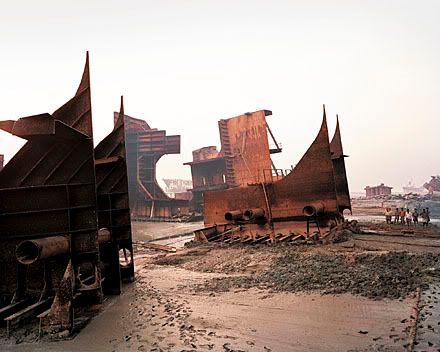 Edward Burtynsky
 takes pictures of big things. His photos capture scenes that, the more I see, remind me of how small I am in comparison. It's frightening, not to see, but to feel how tiny you really are. Check out
Manufactured Landscapes, a documentary of his photography.
I just finished reading a chapter of
The New New Journalism, in which William Langewiesche describes his approach to storytelling. He says he tends to rebel against the idea that we live in a small world. He hates the phrase.
If there's a unifying theme to my work, it is that the "small world" idea is a myth, a serious misreading of our times. It's obvious why it exists -- jet travel, the Internet, the globalizations of markets, the similarity of hotel rooms. But these are largely superficialities. The real world -- of the history-making kind -- simply is not defined by the ease and speed with which people can flit around the globe.
He goes on to argue the size of the world is based not on physical geography, but by human constructs.
Burtynsky, Langewiesche and my own fearful curiosity of mega-objects meet in
Alang, India where people make their living ripping apart ships for scrap metal.
A
photo was taken. A
story was written.
Langewiesche makes a case for how reporting on the shipbreaking industry in Alang usually ends in failed attempts at good storytelling. Reporters, environmentalists, and statesmen approach these people and ask them questions like, "Why do you work here in this very unhealthy environment? Are you unaware of the poisons and dangers?"
He says those are by and large what most people ask them, and it's insulting. Of course they know these things, he says, they're making the rational choice to be there. It plays into his idea of how the world is actually huge...maybe even expanding...because of the differing human ideas.
I thought about Langewiesche when I listened to a recent interview on
This American Life (
#378 - "This I Used to Believe"). A woman struggling with her Christianity came to contact the coach of a Christian high school football team from Texas.
She was struggling with a big idea, the Christian god, and it was interesting because the coach went about explaining Christianity to her in the worst possible way: he gave her pre-packaged answers about free will and God and the fallen world.
Afterward, she's still full of questions, maybe even a little more confused.
It's the reminder of how important it is to approach stories and people and ideas that got me thinking. I doubt I'll ever cover anything as big as those shipbreakers, but I think Langewiesche holds some good rules for reporting, no matter how big the idea.
Labels: Burtynsky, photography, The Atlantic, This American Life, writing
On November 4, 1991, my little brother was born. I was at home though, sitting at my kitchen table, staring into the plastic wrap of a gift basket. At the same time, no more than 300 miles away Oscar Bills, Jr. was shot to death in his driveway. He was in his twenties, like I am today.
I always find it a little eerie when I discover something horrible happened during a time where I can match my exact whereabouts to the event. When you become aware, it's kind of like you momentarily draw a link with the victim or the victim's family. You become witness, at least in some strange way, to something terrible and your brain isn't quite sure how to react.
I found out about Oscar Bill's murder after listening to episode #342 of This American Life ("How to Rest in Peace"). It was easily the most disturbing episode I've ever listened to, but interesting nonetheless. In it they reference to this article in The Atlantic (1997) about the families of murder victims. It's long, so if you don't have some time to spare I'd wait till the weekend.
"She came out of the neighbor's house and asked, "Is she dead?" Al said, "Yes," and Harriett blacked out. Moments later she heard horrible screaming and wailing, like the sounds of a wounded animal way off in the distance, and then she suddenly realized that the sounds were coming from her, that she was screaming and wailing and pounding on Al's chest. In an instant she came to, and saw that Al was sobbing..."
The story talks a lot about grief, which was consequently a huge part of the theme in TAL #342. The article begins with a note on America:
"Americans are fascinated by murders and murderers but not by the families of the people who are killed -- an amazingly numerous group, whose members can turn only to one another for sympathy and understanding."
The story made me think more about a crime reporter's role in telling those types of stories. NPR actually hosted a
roundtable of crime writers in July 2008. They spoke a lot about how race affects their jobs, but also a bit about their actual work routine. One of them said:
"My passion was to cover the communities where the crime happened, rather than the crime."
I like that statement. It's true, reporting like this should be more about how it affects the community you cover, not just the defendant, and certainly not just the crime. Maybe this is a common point, and I'm just new to thinking about it. But it's something I want to remember when I go into the business of journalism.
I am an avid fan of
The Wire (Omar! Word). It's a television show about crime in Baltimore, Maryland - which superficially got me obsessed with following
The Baltimore Sun. I recently ran across a
Sun blog post entitled
"A Reporter's Lament" (just one of the posts at the
Sun's
crime blog).
They post about a lot of things, including how they (the reporters) see themselves as part of the community, their dealings with police, what the murder numbers mean for individual communities, and even a few personal stories from the job. In one post they linked to
this man, a retired police captain turned citizen-crime blogger (remind anyone of a particular character in
The Wire?). He has a different perspective, and it's interesting to compare some of his notes with those authored by the newspapermen.
It's all fascinating. Hearing these people and looking at their
crime maps (2006), it makes me super-curious and even more interested in covering these types of stories, at least for a bit.
ALSO CHECK THESE OUT NPR: Anatomy of a bank takeover NYT: New 1 in 8 Million profile
Labels: blogging, crime, crime beat, maps, New York Times, NPR, The Atlantic, The Baltimore Sun, The Wire, This American Life

My room-redesign makes me read more. For the first time in a long time I have my music, internet, favorite images, and Econ's old webcam all in the same place.
Since Sunday morning I've read more from
The Atlantic,
The New York Times, and
The Onion than I care to recall. I found the
urban wonders of the world, 'Skyped' with someone overseas, and found a weird site called
Old Jews Telling Jokes (check out Diane Hoffman, "Broccoli" first).
With a little free time I caught up on Katie Garner's
favorite commercial, but might have found one she'll like
even more (check out the
official site, too).
All that craziness makes me think
one thing.
I also found a
bird.
Labels: birds, interesting shit, New York Times, The Atlantic, The Onion
I sign up for a lot free things these days, often magazine subscriptions, and none has proven more awesome than
The Atlantic.
I received two issues in as many days (odd how magazines come in bunches), and have spent some extremely satisfying minutes reading about cupcakes,
modern mixology, the recession's
effect on porn, tech-savvy government websites, and
why TV is getting cheesier.
My two favorite stories, oddly enough, deal with the armed forces.
First, in long form: "
The Last Ace" goes into depth on the waning superiority of our Air Force internationally.
Then, in short: "
Army Food" features an Olympic-like cook-off between the world's army chefs.
I was also fairly convinced by a
dangerous water story that begins:
The alcoholic comedian W. C. Fields offered this rationale for not drinking water (absent whiskey): “Fish fuck in it.”
I have even found the regular features and section divisions pleasing, most notably
In a Word by Barbara Wallraff, which prompts readers to coin new words for odd modern day occurrences and feelings. Examples: a word for the pile of clothes that have been worn but you will wear again but didn't properly put away; a word for the time you sit in front of a DVD's repeating menu screen.
I also like the magazine's design and illustrations.
Labels: links, reading, The Atlantic
